




Executive Summary
Key Findings
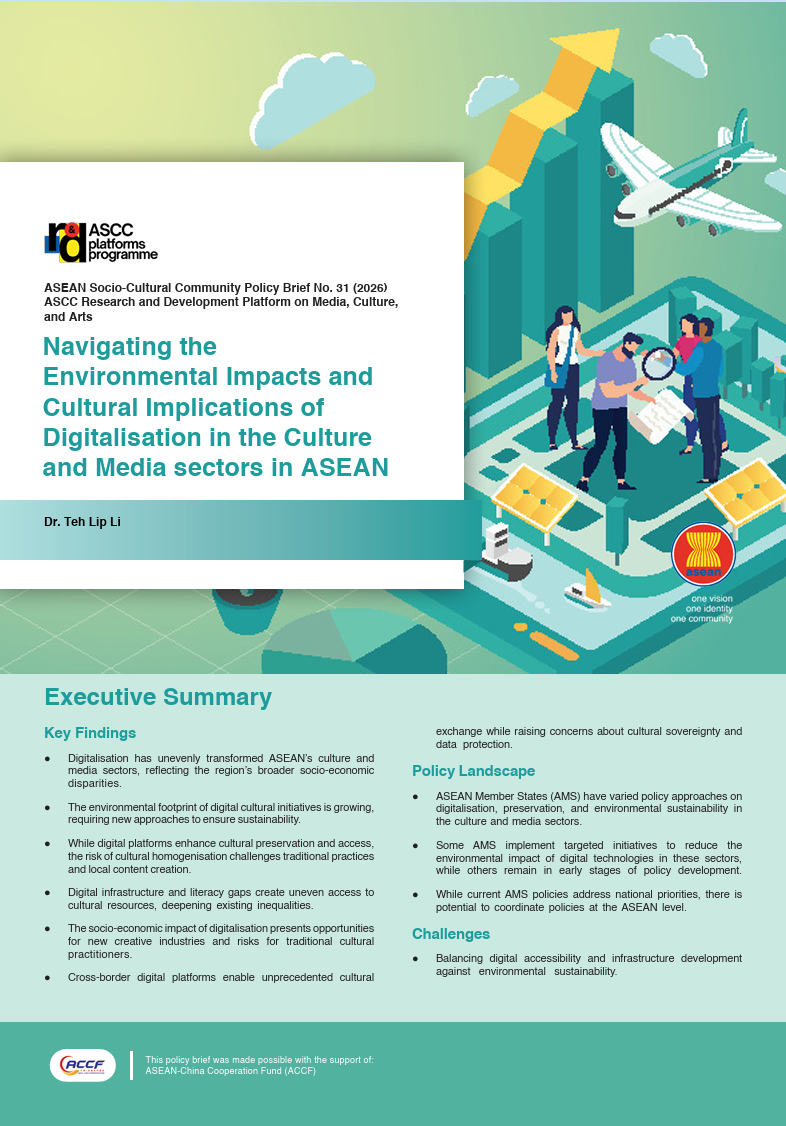
- Digitalisation has unevenly transformed ASEAN’s culture and media sectors, reflecting the region’s broader socio-economic disparities.
- The environmental footprint of digital cultural initiatives is growing, requiring new approaches to ensure sustainability.
- While digital platforms enhance cultural preservation and access, the risk of cultural homogenisation challenges traditional practices and local content creation.
- Digital infrastructure and literacy gaps create uneven access to cultural resources, deepening existing inequalities.
- The socio-economic impact of digitalisation presents opportunities for new creative industries and risks for traditional cultural practitioners.
- Cross-border digital platforms enable unprecedented cultural exchange while raising concerns about cultural sovereignty and data protection.
Policy Landscape
- AMS have varied policy approaches on digitalisation, preservation, and environmental sustainability in the culture and media sectors.
- Some AMS implement targeted initiatives to reduce the environmental impact of digital technologies in these sectors, while others remain in early stages of policy development.
- While current AMS policies address national priorities, there is potential to coordinate policies at the ASEAN level.
Challenges
- Balancing digital accessibility and infrastructure development against environmental sustainability.
- Managing the growing e-waste and energy consumption of digital cultural services.
- Enhancing the visibility and vitality of local cultural content alongside the dominant global digital platforms.
- Ensuring equitable access to digital cultural resources for ASEAN’s diverse populations.
- Protecting data sovereignty and cultural intellectual property rights in digital spaces.
- Developing coherent cross-sector policies that address the interconnectedness of digitalisation, culture, and sustainability.
Policy Recommendations
- Develop ASEAN policies for digital cultural preservation and promotion.
- Encourage investment in digital infrastructure and literacy to bridge the digital divide.
- Implement comprehensive measures to mitigate the environmental impacts of digitalisation in the culture and media sectors.
- Support local content creators and cultural practitioners in the digital transition.
- Foster cross-border collaboration and knowledge sharing.
- Develop adaptive regulatory frameworks for emerging digital challenges.
- Promote sustainable approaches to digital cultural engagement.
- Integrate environmental and cultural considerations into digital development.
These recommendations aim to foster a vibrant, sustainable, and culturally rich digital future for ASEAN’s culture and media sectors, balancing innovation with environmental responsibility and cultural authenticity.
Share